
Can foreigners get married in Colombia?
Yes. Two foreigners, or a foreigner and a Colombian, can marry in Colombia, and neither has to be a resident. A civil marriage is celebrated before a notary or a civil judge; the notary route, created by Decreto 2668 de 1988, is the usual one because it is faster. A Catholic marriage has civil effects once it is registered. Same-sex marriage is legal in Colombia and follows exactly the same procedure.
A visitor who entered as a tourist can marry: no special visa is needed for the ceremony itself.
What are the options for the ceremony?
| Route | Who officiates | Legal effect | At the hacienda |
|---|---|---|---|
| Civil marriage | A notary, or a civil judge | Legal marriage, recorded in the Colombian civil registry | The celebration. Whether the notary officiates on site, for an additional fee, is arranged with the notary office |
| Catholic marriage | A priest | Civil effects once the church record is registered | Capilla de Cristal, a glass chapel authorized for Catholic ceremonies |
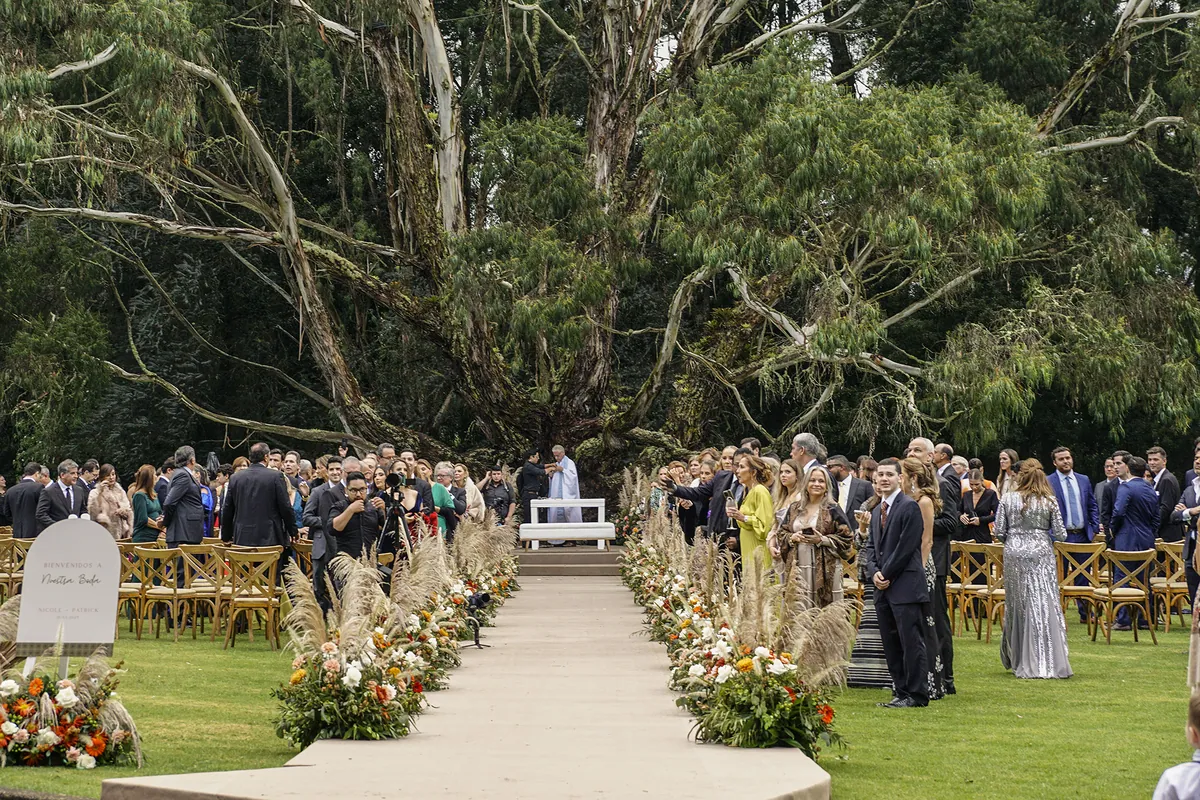
| Symbolic ceremony | An officiant of your choice | None by itself: the couple marries legally at home, or at a notary office on another day | Árbol Ceremonial, under a 250-year-old eucalyptus |
Many couples from abroad choose the symbolic ceremony: they sign the legal marriage in their own country and keep the day in Colombia free of paperwork. Couples who want the Colombian marriage certificate take the civil route.
What documents does a foreigner need for a civil marriage?
Each notary office publishes its own checklist, and they differ in the details. These are the documents notaries ask of a foreigner who does not live in Colombia:
- Valid passport, with the stamp of your entry into Colombia.
- Birth certificate, recently issued. Decreto 1556 de 1989 requires the birth certificate and the proof of single status of a non-resident foreigner to be recent; notaries apply a limit of three months from the date of issue.
- Certificate of single status, or its equivalent. Where a country does not issue one, notaries accept a sworn statement; some accept an affidavit signed at your embassy.
- If you were married before: the divorce decree or the death certificate of your former spouse.
- If you have minor children from a previous relationship: a sworn inventory of their assets (inventario solemne de bienes).
- Two witnesses of legal age.
Foreign public documents must carry an apostille from the country that issued them. If that country is not part of the Hague Apostille Convention, the document is legalized through a Colombian consulate instead. Everything that is not in Spanish needs an official translation by a translator certified in Colombia. A passport needs neither.
If one of you does not speak Spanish, notaries generally require an official translator at the ceremony.
How long does the paperwork take?
- Two to three months before. Choose the notary office and ask for its checklist. Request your documents and apostilles at home, keeping in mind the three-month limit.
- On arrival, or through a representative. Have the documents officially translated and file the marriage application at the notary office.
- Five business days. The notary posts an edict announcing the marriage, as Decreto 2668 de 1988 orders.
- The ceremony. The marriage is signed as a public deed before the notary and two witnesses, and the notary records it in the civil registry.
From filing to ceremony, plan at least four to five weeks, translations included. A wedding planner or a lawyer in Colombia can file on your behalf with a power of attorney, so the two of you need not spend all that time in the country.
Is a Colombian marriage valid in your country?
The notary issues the Colombian civil marriage record (registro civil de matrimonio). To use it abroad, have it apostilled by Colombia's Ministry of Foreign Affairs, a procedure done online, and translated if your country requires it. Each country decides how it records a foreign marriage, so ask your consulate in Bogotá or the registry at home before you travel.
Do you need a visa to marry in Colombia?
Citizens of about one hundred countries, among them the United States, Canada, the United Kingdom, the European Union and Australia, enter Colombia without a visa for stays of up to 90 days. That entry permit is enough to marry. Check the current list of nationalities with Colombia's Ministry of Foreign Affairs before you book flights, and the passport validity your airline asks for.
How do you and your guests get to the hacienda?
International flights land at El Dorado International Airport (BOG), on the west side of Bogotá. Hacienda El Salitre is at Km 13 of the La Calera–Sopó road, 45 minutes by car from Bogotá; from the airport allow about an hour and a half, and more at peak traffic.
Guests usually stay in Bogotá or in the towns near Sopó and travel together in buses or vans that the wedding planner arranges. The hacienda does not offer lodging, but it suggests hotels nearby. It has parking for about 130 vehicles.
What is the weather like, and when is the best time?
Sopó sits on the high Andean plateau, at about 2,600 meters (8,500 feet) above sea level, like Bogotá. The temperature barely changes through the year: an average of about 14 °C (57 °F), afternoons around 17 to 20 °C (63 to 68 °F) and evenings near 9 °C (48 °F).
- Drier periods: December to February, and July to August.
- Rainier periods: April to May, and October to November.
- Daylight: this close to the equator, the sun sets around 6 p.m. all year, so outdoor ceremonies are usually held in the afternoon.
Rain is possible in any month. That is why receptions are held in Salón Ciprés, which is indoors, or under tents in the VIP Gardens of the Casona. Tell your guests to bring a wrap or a jacket for the evening, and to take the first day gently if they come from sea level.
What does a hacienda wedding near Bogotá cost?
Hacienda El Salitre rents the venue by the hour. In 2027, Salón Ciprés costs, for a wedding of up to 100 guests:
| Day | Per hour | Eight hours |
|---|---|---|
| Saturday | COP 1,815,000 (about US$550) | COP 14,520,000 (about US$4,400) |
| Friday and Sunday | COP 1,375,000 (about US$420) | COP 11,000,000 (about US$3,330) |
| Monday to Thursday | COP 1,210,000 (about US$370) | COP 9,680,000 (about US$2,930) |
A ceremony by the Árbol Ceremonial costs COP 3,100,000 (about US$940), and each guest above 100 costs COP 30,000, charged once. Colombian VAT is added to these prices. They cover the venue only: the wedding planner, catering, furniture, decoration and music are hired separately. See all rates.
US dollar amounts are approximate, converted at the official Colombian exchange rate (TRM) of COP 3,301.91 per US dollar on November 13, 2026. Rates and the contract are set in Colombian pesos. The hacienda accepts payments from abroad.
How do you book Hacienda El Salitre from abroad?
- Write in English. Send your date, or a range of dates, and your guest count by WhatsApp or to haciendaelsalitre@gmail.com. The hacienda hosts one event per day, so the date is the first thing to confirm.
- See the place. Look through the gallery of 115 photos and 9 videos and the venues. Visits in person are by appointment.
- Choose your wedding planner. A planner is required. Ask the hacienda for its list of allied planners, which includes planners who work in English.
- Sign the contract. The contract sets the rental price in Colombian pesos, the refundable security deposit and the cancellation terms.
- Start the legal paperwork, if you will marry civilly in Colombia, with the notary office and your planner.
What does the hacienda do, and what does it not do?
- It does: rent the VIP Gardens of the Casona, Salón Ciprés, Rincón Reservado, the Capilla de Cristal and the Árbol Ceremonial, for one event per day; answer in English; recommend planners, vendors and hotels; accept payments from abroad.
- It does not: process the legal marriage, provide catering or decoration, or offer lodging.